
Energy systems are changing rapidly. Engineers face the difficult task of balancing reliability with cost. This challenge is particularly acute in islanded systems. Therefore, effective hybrid microgrid optimization has become a critical skill for modern electrical engineers. In this comprehensive guide, we will explore a MATLAB simulation that solves the classic “Unit Commitment” problem. We will coordinate solar power, diesel generators, and battery storage to minimize operational costs.
The Challenge of Energy Management
Managing a standalone power grid is not simple. You have multiple energy sources with different characteristics. Solar energy is free but intermittent. Conversely, diesel generators are reliable but expensive to operate. Furthermore, battery storage systems have finite capacity and degradation costs.
Without a smart control strategy, you might run the diesel generator unnecessarily. This wastes fuel and money. Alternatively, you might drain the battery too early, leading to a blackout at night. To solve this, we must implement a mathematical approach known as hybrid microgrid optimization. This process calculates the perfect schedule for every asset in the grid over a 24-hour period.
Understanding the Unit Commitment Problem
The core of this project relies on a concept called Unit Commitment. This determines when to turn a generator ON or OFF. This decision is binary. A generator is either running (1) or stopped (0). Standard optimization methods often fail here because they prefer continuous variables.
Consequently, we utilize Mixed-Integer Linear Programming (MILP). This is a powerful mathematical technique. It handles both continuous variables, like power output, and integer variables, like generator status. By using MILP, our hybrid microgrid optimization model can make precise “Yes/No” decisions that save thousands of dollars in operational costs.
For a deeper understanding of the solver we use, you can read about the mixed-integer linear programming algorithm provided by MathWorks.
Setting Up the MATLAB Simulation
Our project is built on three main MATLAB script files. Each file serves a distinct purpose in the simulation architecture.
1. The Data Layer
First, we define our system parameters. We generate realistic load profiles using Gaussian functions. We also simulate solar irradiance curves. Additionally, we define the physical constraints. This includes the battery capacity and the fuel cost of the diesel generator. Accurate data is the foundation of successful microgrid energy management.
2. The Matrix Builder
Next, we translate physics into mathematics. The solver requires the problem in a specific matrix format (Ax≤b). We create constraints that enforce power balance. Supply must equal demand at every hour. Furthermore, we define the battery dynamics. The energy at the current hour must depend on the previous hour’s charge. This creates a “memory” in the system, which is essential for accurate hybrid microgrid optimization.
3. The Master Controller
Finally, we have the main execution script. This file calls the intlinprog solver. It extracts the results and visualizes the data. This modular approach makes the code clean and professional.

Analyzing the Optimization Results
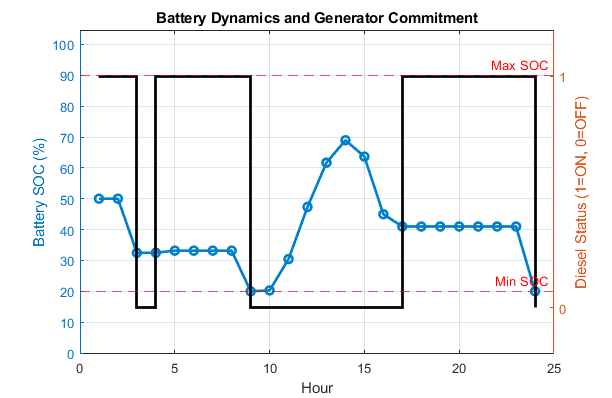
The simulation produces fascinating results. They clearly demonstrate the “smart” behavior of the Energy Management System (EMS). We can visualize this through the generated MATLAB figures.
Smart Switching Logic
The power balance graph reveals the decision-making process. During the early morning, the solar output is zero. Therefore, the diesel generator runs to meet the load. However, as the sun rises, the controller switches tactics. The diesel generator turns off completely. This effectively utilizes the free solar energy. This seamless transition is the hallmark of effective distributed energy scheduling.
Battery Arbitrage
The results also show intelligent battery usage. At noon, the solar generation exceeds the load demand. Instead of curtailing this excess power, the system charges the battery. Later, during the evening peak, the battery discharges. It creates a buffer. This action prevents the expensive diesel generator from turning back on immediately.
Cost Minimization
The most impactful result is the financial summary. The simulation calculates the hourly cost of operation. During solar hours, the cost drops to near zero. By strictly following the hybrid microgrid optimization schedule, the total daily cost is significantly lower than a diesel-only scenario.
Why We Use Mixed-Integer Linear Programming
You might wonder why we chose intlinprog over other solvers like fmincon. The answer lies in the nature of the problem.
fmincon is excellent for smooth, nonlinear problems. However, it struggles with binary decisions. If we used a standard solver, it might suggest running the generator at 0.1% status. This is physically impossible. An engine is either on or it is off.
MILP solvers respect these binary constraints. They search for the global optimum solution. This ensures that our optimal unit commitment schedule is not just theoretically good, but physically executable.
Expanding Your Research
This project serves as a robust foundation. However, you can expand it further. You might consider adding wind energy to the mix. This would introduce more variability. Additionally, you could explore economic load dispatch strategies for larger grids.
Another avenue is demand response optimization. You could allow the system to shed non-critical loads during peak hours. This would further reduce the stress on the battery. Students working on final year projects electrical engineering often combine these concepts to create comprehensive Smart Grid simulations.
Also, consider the health of your storage system. Our current model includes a simple degradation cost. You could research advanced battery models that track chemical aging. This is crucial for long-term planning. For more details on storage technologies, the NREL Energy Storage Research page offers excellent technical data.
Conclusion
The transition to renewable energy requires smart software. Hardware alone is not enough. We need algorithms that can make split-second decisions. This MATLAB project demonstrates exactly how to build those algorithms.
We successfully modeled a complex energy system. We utilized Mixed-Integer Linear Programming to solve the scheduling problem. The results proved that hybrid microgrid optimization significantly reduces operational costs.
By mastering these techniques, you move beyond simple circuit analysis. You enter the world of intelligent power systems. This skill set is in high demand. Whether you are a student or a professional engineer, understanding how to optimize these hybrid resources is essential for the future of the electrical grid.